

Thank you for visiting our site! You landed on this page because you entered a search term similar to this: lowest common denominator LCM codes, here's the result:
| CS 330 | Home | Schedule | Resources |
Homework 6
Recursive programming with integers
Estimated time: 3 hours
Acceptance tests for Assignment 6
About acceptance tests
The objective of this homework is to familiarize yourselves with functions and recursive procedures .
Exercises
Additional voluntary exercises
-
Fibonacci (second part). Write a new version of Fibonacci FastFibb, where the number of recursive calls for N is in O(n) . Help: use a function with one (or several) accumulator parameters. What is the invariant of this function?
-
Divisors and multiples. Into arithmetic, one frequentlyuses highest common factor between two whole numbers. Onecan define it as a function gcd with two integer parameters whichsatisfies the properties
gcd(m, n) = gcd(n, m)
From the second property, one can derive
gcd(m, n) = gcd(m+n, n)
gcd(m, m) = mgcd(m, n) = gcd(r, n) , where R is theremainder of the division of m by n.
Implement a function GCD in OZ, by using these properties. This function takes two whole parameters. Help: Under quelle(s) condition is the derived property useful, i.e. R != m ?Implement a function LCM taking two whole parameters and returning their lowest common multiple . Re-use your function GCD.
-
Classification of the points of the plan. There is a relatively simple technique to assign a natural number to each pair of natural numbers (x, y) . The following figure illustratesthe technique, which consists in numbering the successive diagonals of theplanar quadrant. The numbers of the points are in blue.
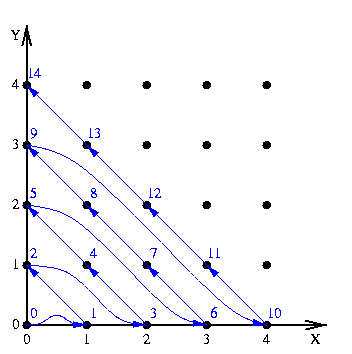
Write a function Number taking as parameter two naturalnumbers x and y , and returning their number according tothe technique illustrated above. We propose two techniques.
-
Express the number of a point according to the number of its predecessor. The predecessor is defined behind while following the blue arrows. Forexample, the successive predecessors of (3, 2) are (4, 1) , (5, 0) , (0, 4) , (1, 3) ... Implement aniterative version of Number.
-
Improve the effectiveness of your function on the basis of two following observations. First of all, a point (X, y) is on thesame diagonal as the point (x+y, 0) . Then, the number of a pointon the x axis, of the form (X, 0) , corresponds to the number ofpoints in the triangle (0, 0) , (x-1, 0) , (0, x-1) . And this number is a triangular number ...
-
Being given a number N , can you find the co-ordinates (x, y) of the corresponding point? Help: Find initially co-ordinate X by comparing N with the numbers of the points of the type (X, 0) . Then, calculate the co-ordinate y. Are your functions iterative? What is their invariant?
-
-
Under the paving stones... a pavement philosophizer posesthe following question: `` How many ways can I pave a square surfacewhose sides are of integer length N with identical square paving stones of integer length and cover the whole square? '' the example below shows four possible pavings for n=6 . From left to right, paving stones whose side lengths are 6, 3, 2and 1 were used.
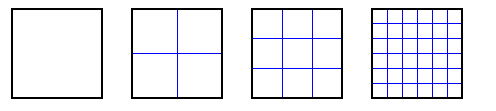
-
Write a function NumberPaves which takes N in parameter and returns the number of pavings in question.
-
Suppose now that the paver carries out all possible pavings. How many paving stones will it have used? In the n=6 example , there is 1+4+9+36=50 of it . Write a function NumberPaves who takes N in parameter and returns this number.
-