

Thank you for visiting our site! You landed on this page because you entered a search term similar to this: examples of linear simultaneous equations problems solved by gaussian elimination.We have an extensive database of resources on examples of linear simultaneous equations problems solved by gaussian elimination. Below is one of them. If you need further help, please take a look at our software "Algebrator", a software program that can solve any algebra problem you enter!
More on Linear Systems
Number of Solutions
Most linear systems you will encounter will have exactly one solution.However, it is possible that there are no solutions, or infinitely many.(It is not possible that there are exactly two solutions.)
Let's take a closer look. It never hurts in any investigation to lookat the simplest possible case first. So consider again the singleequation
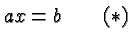
 and
and  are parameters and
  is the variable whosevalue needs to be determined.There are three possible cases:
 In this case dividing by on both sides of
 gives the unique solution
 and
and  . In this case turns into
 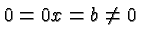 .Since
  is impossible there is no solution.
and  . In that case turns into
  which is true for all numbers . There are infinitely manysolutions.
It is clear since we cover all possibilities above that it isimpossible for the to have precisely  , or
, or  , or anyfinite number, of solutions. Compare this for example with quadratic equations which may have
  ,
,  , or , but neverany other number of (real) solutions.
Next Consider two equations in two unknowns, let's say
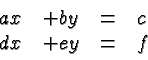
Each of these two equations defines a line in the cartesian plane . All solutions are the coordinates of a pointwhere the two lines intersect.There are again three possibilities.

Figure 1: Unique Solution of two equations in two unknowns.
The lines intersect in one point. There is a unique solution(i..e, the coordinates of that point). An example is provided by
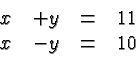
 and
and  , as shown in Figure 1.
Figure 2: No Solution of two equations in two unknowns.
The lines are parallel but distinct. They never intersect andthere is no solution.An example is provided by
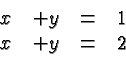 and .
and . 
Figure 3: Infinitely many solutions of two equations in two unknowns.
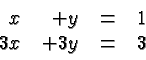
The lines are identical. Any point on the lines provides asolution. A trivial example can be obtained by writing the sameequation twice. A less trivial example is
More than two Equations. Similar considerations apply to systems of more than two equations,but this is a subject beyond the scope of this class. You will learnmore when you take a class on Linear Algebra.
A Complicated Example
Suppose we want to find a quartic polynomial whose value equals for
for 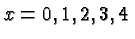 . The purpose of this exercise might be toto approximate by a polynomial on a calculatorthat cannot evaluate for non-integer directly.Approximating functions is a huge subject, here we just use thisproblem as an example for a more complicated linear system.
Let's write our quartic polynomial as

We want it to satisfy the equations
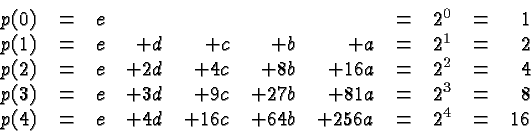
This is a linear system of five equations in the five unknowns , , ,
,  , and
, and  .
.
The table below is set up asdiscussed except that whenever an entry is it is left blankto clarify the reduced systems.
![\begin{displaymath}\begin{array}{rrrrrrrrr}\hbox{equation} & & e & d & c & b &......{[15] = [14]-4[13]} & & & & & & 24 & 1 & 25 \\\end{array}\end{displaymath}](img31_3.gif)
Equation ![$ [1] $](img32_3.gif) is very special, it tells us right away that
is very special, it tells us right away that  .We use that equation to eliminate from the remaining equationswhich gives us four equations (
![$ [6] $](img34_2.gif) through
through ![$ [9] $](img35_2.gif) ) in the fourunknowns , , and .
) in the fourunknowns , , and .
Equation ![$ [15] $](img36_2.gif) is
is  which means
 .Substituting the value of into equation
 ![$ [13] $](img39.gif) gives
gives 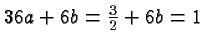 which implies
  .Substituting and into equation
 ![$ [10] $](img42.gif) gives the equation
gives the equation which implies
 . Finally, substituting , and into equation gives
 whichimplies
  .
.
Putting the underlined results together (and writing everything overthe common denominator  ) gives
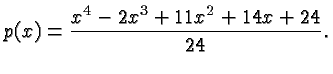

Figure 4: A polynomial approximation of  .
.
Figure 4 shows the graph of  (red) as well as the graphof (green). It is apparent that is a good approximation of
  in the interval from to
  . There are other andmore effective ways of computing polynomials like . However,this example illustrates how Gaussian Elimination and BackwardSubstitution can be used to solve a linear system. In this particularlinear system we were fortunate in that the elimination proceeded in astraightforward way without fractional arithmetic. It happensfrequently that linear systems have a special structure that can beeffectively exploited.
A final word on computing the row sums. They appear to be a waste ofeffort when the problem is all solved. However, when I first computedthe entries in the above table I made several mistakes that Idiscovered immediately because of the row sums. There is a goodchance you will save yourself a lot of time and aggravation bycarrying them along in your own calculations.