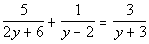
Thank you for visiting our site! You landed on this page because you entered a search term similar to this: Multiplying rational expression fractions solver, here's the result:
College Algebra Tutorial 15: Equations with Rational Expressions
Learning Objectives
After completing this tutorial, you should be able to:
Solve equations with rational expressions.
Know if a solution is an extraneous solution or not.
Introduction
The equations that we will be working with in this section all haverational expressions (fractions - yuck!). After a few magicalsteps, we can transform these equations with rational expressions intolinear equations. From there, you solve the linear equation likeyou normally do. If you need a review on how to solve a linear equation,feel free to
No matter what type of equation you are working with in this section,the ultimate goal is to get your variable on one side and everything elseon the other side using inverse operations.
Tutorial
Solving Rational Equations
Step 1: Simplifyby removing the fractions.
We do this by multiplying both sides by the LCD.
If you need a review on finding the LCD of a rational expression,
Note that even though this is not the same as adding and subtractingrational expressions, you still find the LCD in the same manner. Soif you go to this link, just look at finding the LCD, NOT adding and subtractingrational expressions.
Step 2: Solve theremaining equation.
In this tutorial the remaining equations will all be linear.
If you need a review on solving linear equations go
Step 3: Check forextraneous solutions.
For rational equations, extraneous solutions are values that causeany denominator in the original problem to be 0. Of course, whenwe have 0 in the denominator we have an expression that is undefined. So, we would have to throw out any values that would cause the denominatorto be 0.
In Tutorial14: Linear Equations, I told you that when you multiply both sidesby the same constant that the two sides would remain equal to each other.But we can not guarantee that if you are multiplying by an expression thathas the variable you are solving for - which is the situation we will berunning into in this section. Sometimes this will cause extraneoussolutions.
Example1: Solve for y.
Step 1: Simplifyby removing the fractions.
*Mult.both sides by LCD of 3y
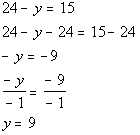
Step 2: Solvethe remaining equation.
*Inverse of add. 24 is sub. 24
*Inverse of mult. by -1 is div. by -1
Step 3: Checkfor extraneous solutions.
Note that 9 does not cause any denominators to be zero. So itis not an extraneous solution.
9 is the solution to our equation.
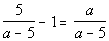
Example2: Solve for a.
Step 1: Simplifyby removing the fractions.
*Factor 1st den.
*Mult.both sides by LCD of (a + 3)(a- 2)
Step 2: Solvethe remaining equation.
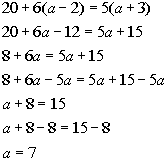
*Remove ( ) by using dist. prop.
*Get all a termson one side
*Inverse of add. 8 is sub. 8
Step 3: Checkfor extraneous solutions.
Note that 7 does not cause any denominators to be zero. So itis not an extraneous solution.
7 is the solution to our equation.
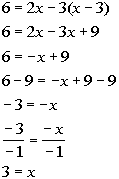
Example3: Solve for x.
Step 1: Simplifyby removing the fractions.
*Mult.both sides by LCD of 2(x - 3)
Step 2: Solvethe remaining equation.
*Remove ( ) by using dist. prop.
*Inverse of add. 9 is sub. 9
*Inverse of mult. by -1 is div. by -1
Step 3: Checkfor extraneous solutions.
Note that 3 does cause two of the denominators to be zero.
So 3 is an extraneous solution. That means there is nosolution.
The answer is NO solution.
Practice Problems
These are practice problems to help bring you to the next level. It will allow you to check and see if you have an understanding of thesetypes of problems. Math works just like anythingelse, if you want to get good at it, then you need to practice it. Even the best athletes and musicians had help along the way and lots ofpractice, practice, practice, to get good at their sport or instrument. In fact there is no such thing as too much practice.
To get the most out of these, you should work the problem out onyour own and then check your answer by clicking on the link for the answer/discussionfor that problem. At the link you will find the answeras well as any steps that went into finding that answer.
PracticeProblems 1a - 1b:
Solve the given equation.
1a. (answer/discussionto 1a)
1b. (answer/discussionto 1b)
Need Extra Help on These Topics?
The following is a webpage that can assistyou in the topics that were covered on this page:
Problems 1 and 2 of this part of the webpage helps with solving fractionalequations that lead to linear equations. ONLYdo problems 1 and 2.

 Learning Objectives
 Example1: Solve
  for y.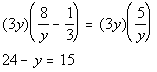
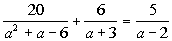 for a.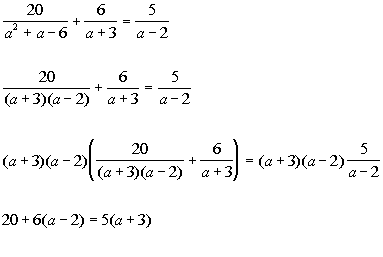
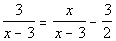 for x.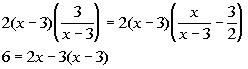
 PracticeProblems 1a - 1b: